Hundreds gathered outside of Minneapolis City Hall on Saturday to oppose far-right provocateur.
Jake Lang is already familiar to Minneapolis activists, he spent four years in prison for his role in the January 6 attack on the U.S. Capitol before receiving a presidential pardon in 2025.
Earlier this year, he organized an anti-Islam rally outside Minneapolis City Hall that was overwhelmed by counter-protesters. He later returned to Minnesota and was charged with felony property damage after destroying part of an anti-ICE ice sculpture at the State Capitol.
This time, Lang said he was coming to Minneapolis to support a Rochester woman who called a Black autistic child a racial slur. During Saturday’s confrontation, the Star Tribune reported that Lang held a large sign displaying the N-word.
Hundreds of people waited outside of City Hall mobilized specifically to oppose him.
Around noon, Lang arrived with six other people in two vehicles. According to Minneapolis police, both vehicles drove illegally onto the City Hall sidewalk and toward the crowd. The vehicles were surrounded, chemical irritants were deployed, objects were thrown, and what had been an organized effort to oppose Lang’s presence became a rapidly developing riot. Police ultimately arrested all seven people who arrived in the vehicles on probable cause of riot. Four other people were arrested near City Hall.
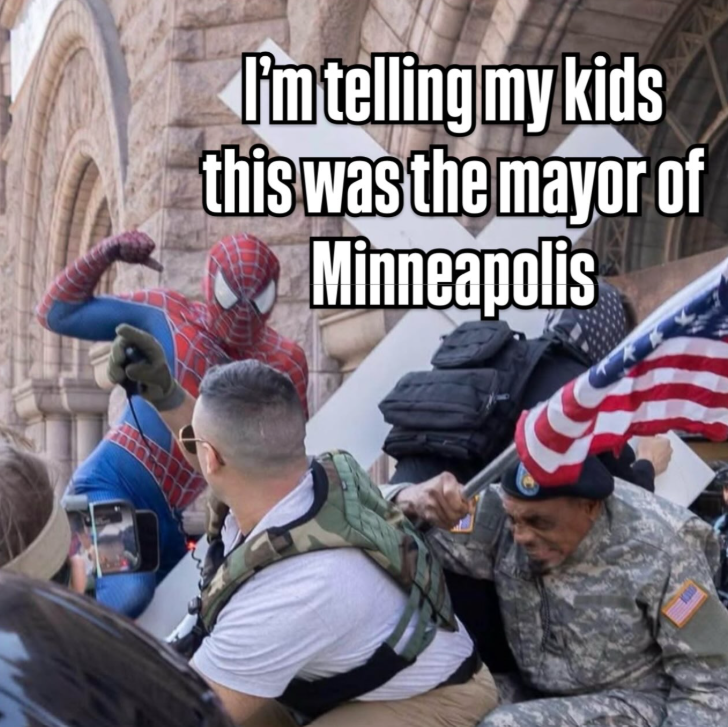
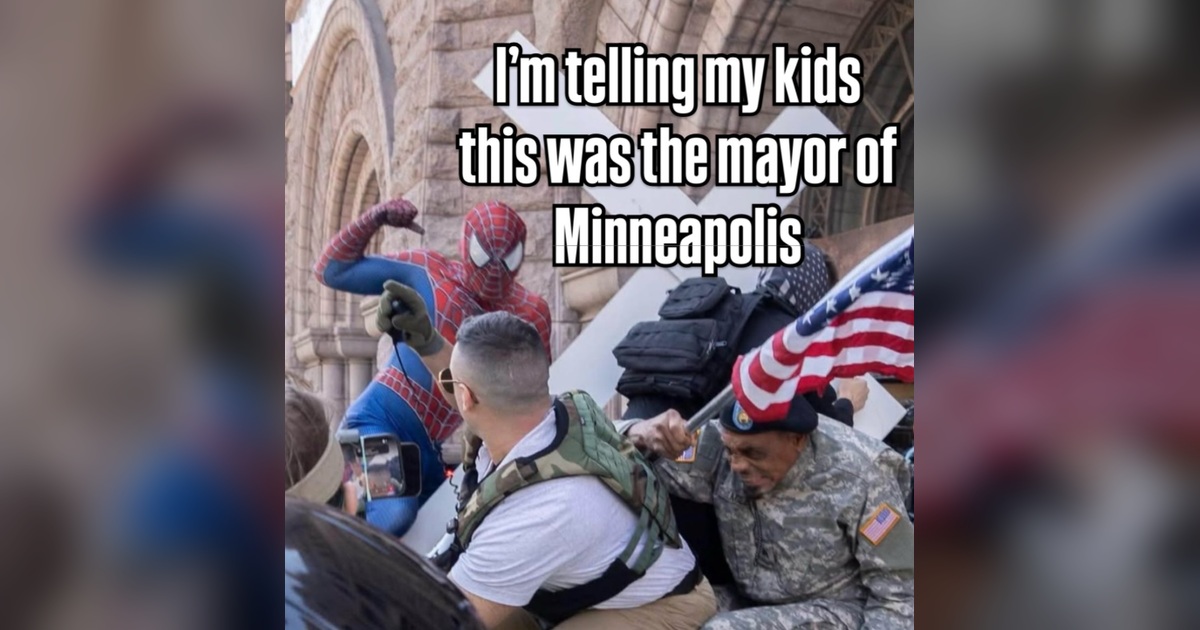
Spider-Man became a internet sensation but for organizers, the more important lesson is how Lang’s arrival changed the conditions on the ground, how a crowd responded to an apparent provocation, and how quickly a demonstration can move from organized opposition to a situation involving vehicles, chemical irritants, physical confrontations and arrests.
A challenge for organizers is figuring out how to confront people who deliberately generate outrage and conflict without allowing those people to determine the tactics, safety conditions or public narrative of the response. Provocation was not incidental to Lang’s presence in Minneapolis, it was central to the context in which organizers were operating.
Why Police Delayed the Arrests
Police moved Lang’s vehicles away from City Hall without immediately arresting them.
Interim Minneapolis Police Chief Bill Peterson said that officers believed attempting to arrest the seven people while their vehicles were surrounded by a large, agitated crowd would create even more of a safety risk. “It was not safe for us to make any sort of arrest on those individuals in that large crowd,” Peterson said.
According to MPD, officers surrounded the vehicles, worked to move them off the sidewalk and away from the crowd, and then communicated their direction of travel to other law-enforcement agencies for their arrest.
Minnesota State Patrol stopped the first vehicle near Washington Avenue and southbound Interstate 35W. Minneapolis officers arrested all three occupants on probable cause of riot and impounded the vehicle.
Bloomington police stopped the second vehicle near Lindau Lane and IKEA Way. Minneapolis officers arrested all four occupants on probable cause of riot, including Lang.
Four additional people were arrested near City Hall, bringing the total to 11.
Three Minneapolis police officers suffered non-life-threatening injuries, including one who was taken to a hospital and later released.
As of Monday night, Lang remained in the Hennepin County Jail and has not yet been formally charged in connection with Saturday’s confrontation. Officials said he could face felony or gross-misdemeanor riot charges.
The man dressed as Spider-Man, was released Saturday evening. By Monday night, authorities said he was charged with misdemeanor assault.
The investigation remains active and Minneapolis police said investigators were reviewing video and other evidence and that additional arrests or charges remained possible.
#FreeSpiderMan
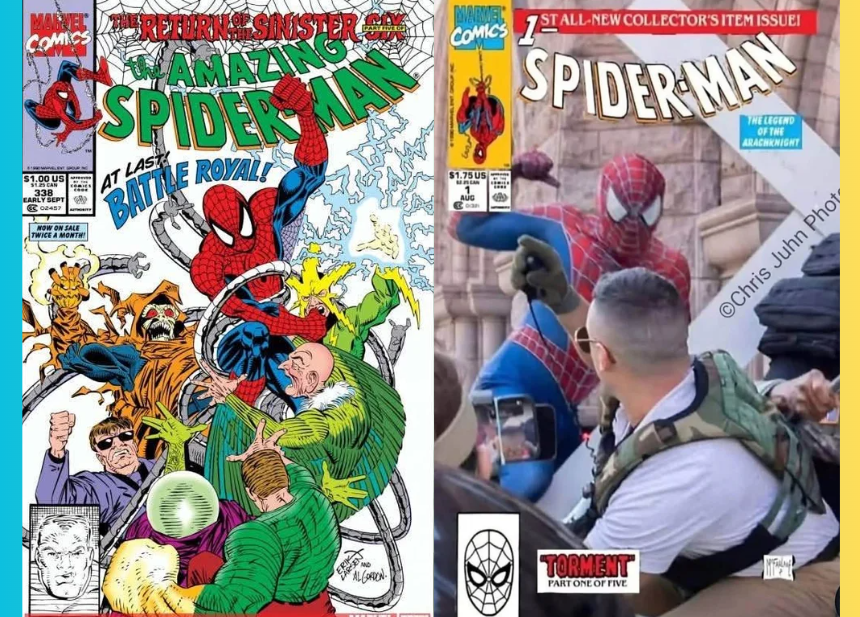
Within hours, clips of Spider-Man confronting Lang spread far and wide throughout Minneapolis and across the internet along with the trending hashtag: #FreeSpiderMan
What Organizers Can Learn From Minneapolis
Minneapolis residents deserve credit for continuing to show up. Between repeated confrontations with the Trump administration, federal immigration enforcement actions, and now provocateurs like Jake Lang bringing their politics directly into the city, people there have repeatedly refused to accept what’s happening around them.
Hundreds of residents came to City Hall and made it clear that Jake Lang is not welcome. The lessons from Saturday are how organizers can build on that willingness to fight back while making future actions even safer, more coordinated and harder for provocateurs to disrupt.
Plan for vehicles, not just people
Before an action, organizers can identify vehicle access points, establish escape routes, assign volunteers to watch approaches and decide how participants respond if a vehicle enters a pedestrian area.
The aim here is to reduce the number of decisions a crowd has to make in the heated moment. A vehicle surrounded by people creates a dangerous environment even at low speed, especially when visibility is poor and emotions are high.
Decide what a successful event looks like before provocateurs arrive
Counterprotesters face people who try to provoke a reaction.
Organizers should decide what the action is meant to accomplish. Is it to visibly outnumber them? Protect a targeted community? Prevent intimidation? Document extremist activity? Different goals call for different tactics.
Let the Community Speak for Itself
Before Saturday, Minneapolis Mayor Jacob Frey encouraged residents not to give Lang attention. Local organizers made a different choice. They showed up.
One organizer later told reporters, “When we actually show up and confront them, it shows that we can win and that we outnumber them.”
Ignoring someone like Lang may deny him attention, but a large counterprotest also sends a different message that his views are not representative of the community, and people are willing to publicly stand against them.
The stronger the turnout, the clearer that message becomes. Coordinated signs, chants, speakers, visual messaging and disciplined crowd positioning can all reinforce the point that Lang came to Minneapolis, and Minneapolis overwhelmingly rejected him.
Treat documentation as a priority
Designated volunteers can capture wide shot videos, vehicle movements, entrances, police activity and interactions. That recording can later help establish a timeline when participants, police and online accounts give conflicting stories of what happened.
For demonstrations with greater legal risk, organizers can also request trained National Lawyers Guild Legal Observers.
Prepare arrest support before it is needed
11 arrests also show why legal support should be arranged before a high-risk action.
Organizers can establish legal-support contact(s), use a buddy system, determine how arrests will be tracked and identify who can provide jail support.
National Lawyers Guild can also provide legal observers and other mass-defense resources in some areas.
Plan for what comes afterward
One participant can become the public face of an entire event or protest within minutes. 🕷️ Which is exactly what happened in Minneapolis. Hundreds of people opposed Lang, but Spider-Man became the image seen around the country.
Organizers can’t control which clip goes viral, but they can prepare to explain the big picture. Someone should be responsible for preserving footage, confirming facts, maintaining a timeline and communicating what happened.
Protect the Resistance, Not the Provocateur
What happened Saturday demonstrates the power and the complexity of resistance.
Minneapolis residents succeeded at one of the most basic goals of a counterprotest: they made it unmistakably clear that Jake Lang did not represent their community and would not appear there without substantial opposition.
The events that followed also created useful lessons for organizers. Large turnout can’t control vehicle access, prepare people for arrests, document fast-moving incidents or communicate when the situation changes.
Related Resources
- ACLU: Protesters’ Rights Updated in June 2026, this guide covers First Amendment protections, arrests, searches, photographing police and what to document if you believe your rights were violated.
- National Lawyers Guild: Mass Defense Program Resources for organizers preparing for demonstrations, including legal support structures, Know Your Rights training, Legal Observers and arrest support.
- National Lawyers Guild: Request Legal Observers Explains what trained Legal Observers do and how organizers can request them through a local NLG chapter before an action.
- National Lawyers Guild: Protest Tools Includes legal-hotline information, jail and arrest-support resources, legal-defense information and guidance for organizers expecting elevated arrest risk.
- American Friends Service Committee: A Guide to Protesting Practical resources covering protest preparation, safety, digital security, bystander intervention and other tools useful before an action begins.
- AFSC: Preparing for Election-Related Violence Particularly useful for experienced organizers. It includes resources on situational awareness, protest health and safety, chemical irritants, bystander intervention and de-escalation.
Photo Credit @minne_anna_polis